

Quick Overview: To choose a 2027 wedding date before photographers...
Read More
Share On Social Media
Wedding photography contract: 10 things every UK couple must check
Quick Overview:
- A wedding photography contract is a legally binding document – read every clause before signing, not after.
- Under UK law, photographers retain copyright over your images unless the contract explicitly assigns those rights to you.
- Always confirm the cancellation and deposit terms in writing, including what happens if the photographer cancels.
- Check that your photographer holds public liability insurance – most UK venues require a minimum of £5 million coverage (Once in a Lifetime Photography, 2025).
- A backup plan clause is not optional – if the photographer falls ill on the day, you need a named replacement in the contract.
What a Wedding Photography Contract Actually Is

A wedding photography contract is a legally binding agreement between you and your photographer. It sets out what they will deliver, when they will deliver it, how much you will pay, and what happens if something goes wrong on either side.
Many couples treat it as a formality and sign without reading. That is a mistake. The contract is your only protection if photos arrive six months late, look nothing like the portfolio you were shown, or the photographer does not show up at all.
Before you even reach the contract stage, it pays to ask the right questions. The 10 Questions to Ask Before Hiring a Wedding Photographer in the UK guide from Lens of Lights covers exactly what to raise before you book – and before any paperwork is signed.
The 10 things below cover every clause that matters. Work through each one before you sign.
1. Who Is Actually Named in the Contract
The contract must name the specific photographer who will shoot your wedding – not just the studio or company name. This matters because some photographers book weddings under a brand name and then send a second shooter or associate on the day.
Ask directly: “Is the person named in this contract the person who will photograph my wedding?” If the answer is yes, that name must appear in the contract. If the photographer works with a team, the contract should state clearly who leads the shoot.
If you are also booking videography alongside photography, confirm that both the lead photographer and lead videographer are named. Lens of Lights offers combined wedding photography and videography packages where both roles are handled under a single agreement – a cleaner arrangement than managing two separate contracts.
2. Exact Hours and Location Coverage
The contract should state the precise start and finish times for coverage – for example, “from 11:00 AM during bridal preparations at [venue] to 10:00 PM at the end of the first dance.” Vague coverage descriptions like “all day” create disputes.
Also, confirm what counts as a chargeable extra – overtime, travel over a set mileage, a second location, or additional hours at the reception all need to be priced in the contract, not invoiced as a surprise after the day.
If you are still finalising your venue, the top wedding venues in London guide from Lens of Lights includes location details to help you plan travel logistics before you finalise the contract.
3. Exactly What You Will Receive – and When
This is where most disputes start. The contract must specify:
- The minimum number of edited images you will receive
- The format (high-resolution digital files, prints, or an album)
- How images are delivered – online gallery, USB, or download link
- The delivery timeline – a clear number of weeks, not “as soon as possible
The turnaround time and delivery method should be written into the contract. Check whether RAW files are included, as most photographers do not provide them by default. If you want RAW files, negotiate that before signing.
Delivery timelines also vary depending on the style of photography. Candid documentary shoots typically require less post-production time than heavily edited editorial portraits. The UK Wedding Photography Trends for 2026 post explains the main styles currently popular with UK couples – useful context when you are agreeing deliverables in a contract.
4. Payment Terms, Deposit, and What Happens If You Cancel
Your contract should state the total fee, the deposit amount and due date, overtime charges, and what is included.
Most UK photographers charge a non-refundable deposit of 20%-30% to hold the date. That is standard and legally defensible. What you need to check is the cancellation sliding scale closer to the wedding date.
Under the Consumer Rights Act 2015, cancellation fees must be fair, transparent, and proportionate to the photographer’s likely loss. A clause that requires payment of 100% of the fee if you cancel more than 12 months in advance could be challenged as unfair.
The Competition and Markets Authority publishes guidance on what counts as an unfair contract term under UK law – worth reading if any clause in your contract seems disproportionate.
Ask the photographer to explain their cancellation schedule in plain language before you agree. Also check: what happens if the photographer cancels? The contract should state whether you receive a full refund, a replacement photographer, or both.
For a clear look at how pricing connects to quality, the Lens of Lights blog post Why Cheap Wedding Photography Could Cost You More in the Long Run breaks down the real risks of choosing a photographer based on price alone – relevant reading before you finalise your budget and deposit terms.
5. Copyright and Image Usage Rights
Under the Copyright, Designs and Patents Act 1988, photographers automatically own the copyright to every image they take the moment the shutter fires. No registration is required. That copyright lasts for the photographer’s lifetime plus 70 years (Sprintlaw UK, 2025).
This does not mean you cannot use your own wedding photos – but it does mean your usage rights must be spelt out in the contract. A standard clause grants couples a licence for personal use: printing, sharing on social media, and using images in albums. It does not cover commercial use.
Copyright sits with the photographer unless it is formally assigned in the contract. If you want full ownership, that assignment must be in writing, and you expect to pay more for it.
Also, check whether the photographer can use your images for their portfolio, website, or social media. Most contracts include this as standard. If you want your wedding kept private, you need an opt-out clause. You can review how a professional UK photographer presents real client work in the Lens of Lights portfolio to understand what “portfolio use” typically looks like in practice.
6. The Backup Photographer Clause
If your photographer is ill, injured, or has a family emergency on your wedding day, what happens?
A professional photographer should have a written backup plan in the contract. The minimum acceptable clause names a specific replacement photographer of similar skill and experience. Even better is a clause stating the replacement will be from the same studio and work at no extra cost.
This connects directly to why experience matters when choosing a photographer. A well-established studio with a team in place is far more likely to have a credible backup plan than a sole trader working alone. The Lens of Lights post Why Experience Matters More Than Price in Wedding Photography goes into this in detail.
7. Insurance – What the Photographer Must Hold
Most UK wedding venues require photographers to provide proof of public liability insurance with a minimum of £5 million coverage, as well as Portable Appliance Testing (PAT) certificates and, more recently, health and safety risk assessments.
Ask your photographer for their certificate of insurance before the wedding day. The contract should confirm they hold both public liability insurance and professional indemnity insurance. Public liability covers physical accidents, such as a guest tripping over a tripod. Professional indemnity covers claims about the quality or delivery of the work itself.
The Health and Safety Executive (HSE) sets out when employers’ liability insurance is legally required in the UK – relevant if your photographer works with assistants or second shooters on the day. If a photographer cannot provide proof of insurance, that is a red flag worth taking seriously.
8. Force Majeure – What Counts as an Unavoidable Event
A force majeure clause sets out what happens if the wedding cannot go ahead due to events beyond either party’s control, such as extreme weather, a venue fire, or a national emergency.
Check whether the clause covers just natural disasters or also venue closures and third-party failures. Check whether you receive a full refund, a credit toward a rescheduled date, or nothing at all. Pandemic-era disputes caught many couples off guard because their contracts lacked any force majeure language.
Force majeure, rescheduling policies, and refund terms should all be stated clearly in the contract to protect both parties. A fair clause protects both sides – not just the photographer.
If you are still working through your wedding planning alongside sorting your photography contract, the Lens of Lights wedding planning service handles supplier coordination alongside photography and videography, which can reduce the risk of conflicting terms across multiple contracts.
9. GDPR and How Your Images Are Stored
This clause is overlooked by almost every couple – and it matters.
Photos of identifiable people are personal data under the UK GDPR and the Data Protection Act 2018.
The Information Commissioner’s Office (ICO) is the UK’s independent authority on data protection. It publishes clear guidance on how photographers must handle images of individuals, including the lawful basis for processing, secure storage, and individuals’ rights to have their images deleted.
Your contract or the photographer’s privacy policy should state how long they retain your images, whether they store them on UK or EU servers, and whether any third parties (e.g., editing services or cloud storage providers) have access to the files. If you want your images deleted after a certain period, request that in writing.
10. Dispute Resolution – What Happens If Things Go Wrong
The final clause to check is the one on disputes. A well-written contract states that disputes are governed by English and Welsh law (or Scottish law if relevant) and outlines a process: first, a written complaint; then mediation; and, if needed, legal action.
For UK photographers operating as a business, the contract should include full legal names, business names, and company numbers where applicable. That information is what you need if you ever have to pursue a claim.
If mediation fails, Citizens Advice provides a plain-English guide to making a small claims court case in England and Wales. For disputes under £10,000, you can file a claim through the government’s Money Claim Online service without needing a solicitor.
If the contract does not mention dispute resolution, ask the photographer to add a clause before you sign. It is a reasonable request from any professional.
Common Mistakes UK Couples Make When Signing
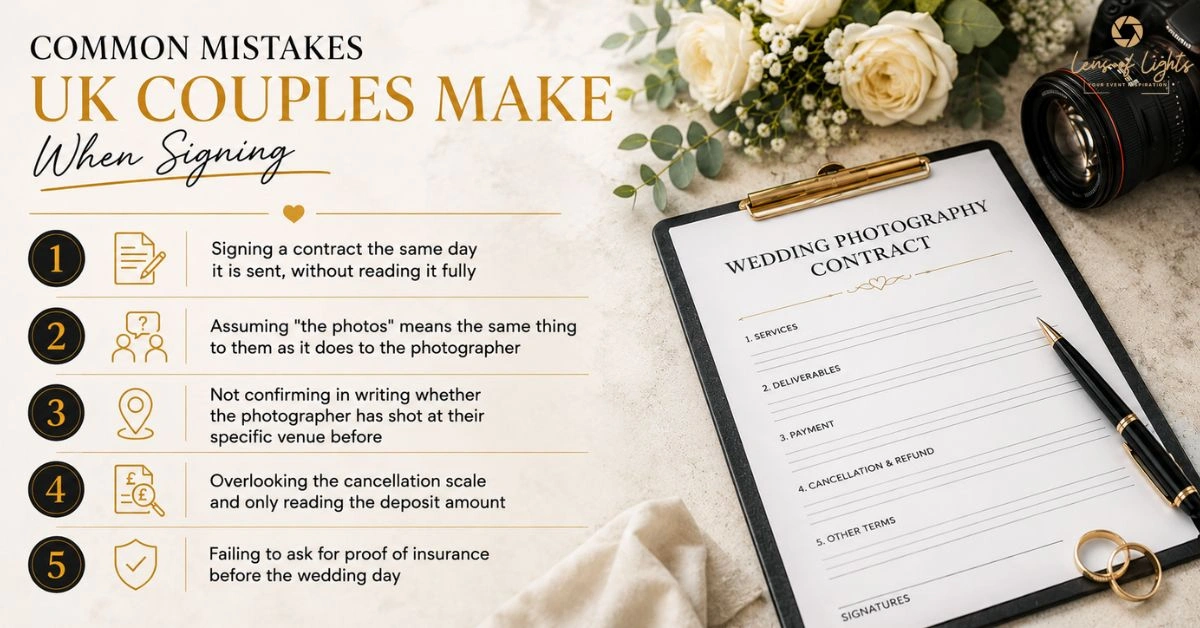
- Signing a contract the same day it is sent, without reading it fully
- Assuming “the photos” means the same thing to them as it does to the photographer
- Not confirming in writing whether the photographer has shot at their specific venue before
- Overlooking the cancellation scale and only reading the deposit amount
- Failing to ask for proof of insurance before the wedding day
If you want to see what a fully transparent, professional booking process looks like from the start, get in touch with Lens of Lights – all contract terms and insurance details are provided upfront before you commit.
Frequently Asked Questions
Who owns the copyright to my wedding photos in the UK?
The photographer owns the copyright by default under the Copyright, Designs and Patents Act 1988. You receive a licence to use the images for personal purposes unless the contract explicitly transfers copyright to you. If full ownership matters to you, negotiate a copyright assignment clause before signing.
Is a wedding photography deposit refundable?
Most deposits are non-refundable – this compensates the photographer for turning away other bookings on your date. However, under the Consumer Rights Act 2015, cancellation fees must be proportionate to the photographer’s actual loss. Check the full cancellation schedule before paying.
What should I do if my photographer cancels before the wedding?
You are entitled to a full refund of any money paid. The contract should also state whether the photographer provides a replacement. If they cannot fulfil the booking and the contract does not protect you, you can pursue a claim through the small claims court via GOV.UK.
How long should a wedding photographer take to deliver photos?
Delivery timelines vary, but 6-12 weeks is typical for a fully edited gallery. The specific timeline must appear in your contract. If the contract says “delivery within a reasonable time,” ask the photographer to replace that phrase with a specific number of weeks.
Does my photographer need public liability insurance in the UK?
They are not legally required to hold it in all circumstances. Still, most wedding venues require a minimum of £5 million public liability cover before allowing a photographer to work on site. Always ask for proof of insurance before the wedding day.
What is a force majeure clause in a photography contract?
Force majeure is a clause that releases both parties from their obligations when an event outside their control prevents the wedding from happening – such as extreme weather, a venue fire, or a government-imposed restriction. Check whether your contract includes one and what it entitles you to.
Can I share my wedding photos on social media?
Yes, in almost every case – but only for personal use unless the contract states otherwise. The photographer typically retains the right to use images from your wedding in their portfolio and on social media. If you want a privacy clause that prevents this, request one before signing. You can also read about how wedding videography trends in 2026 are shaping how couples share their visual memories online.
Related Articles:

London Registry Office Wedding Photography: Complete Guide
Quick Overview: London registry office wedding photography is short, fast...
Read More
12 Best Wedding Drone Shots Ideas for UK Couples in 2027
Quick Overview: The best wedding drone shots for UK couples...
Read More
9 Affordable Micro Wedding Venues in London
Quick Overview: The best affordable micro wedding venues in London...
Read More