

Quick Overview: A wedding videographer in London typically costs £1,800-£4,500,...
Read More
Share On Social Media
Rainy Wedding Day Photography in the UK: The Couple’s Guide to Getting Amazing Shots
Quick Overview:
- Rain on your UK wedding day does not ruin photos – it often produces the most dramatic, memorable shots of the day.
- The single most important preparation is talking to your photographer at least two weeks before the wedding to agree on a wet-weather shot list.
- Umbrellas, window light, and puddle reflections are three free tools that turn grey skies into a visual advantage.
- Roughly 60% of UK weddings experience some rainfall on the day (Met Office, 2023), so planning for rain is planning for the likely.
- This guide covers gear, poses, locations, timeline adjustments, and what to say to your photographer so nothing is left to chance.
Why Rainy Wedding Day Photography in the UK Can Produce Your Best Shots
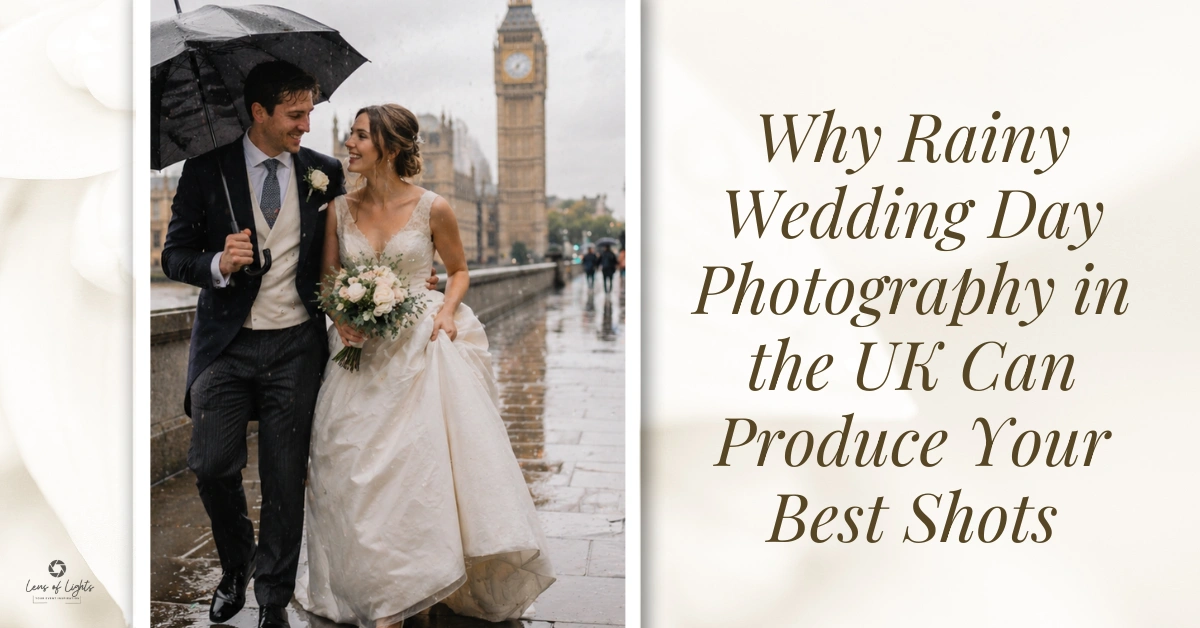
Rain does not ruin UK wedding photography – poor preparation does. When a couple and photographer are ready for wet weather, rain adds atmosphere, depth, and emotion that clear-sky shots rarely match. Wet cobblestones reflect light. Overcast skies act as a natural diffuser, removing harsh shadows from faces. Dark clouds give images a cinematic quality.
The UK’s grey, changeable weather is not a liability. It is one of the reasons British wedding photography has a worldwide reputation for moody, story-driven imagery.
The couples who get the most out of a rainy wedding day are the ones who planned for it specifically – not just hoped it would stay dry. If you’re still in the early stages of planning, our guide to planning a London wedding covers how to build a flexible timeline that accounts for British weather from the start.
How UK Weather Actually Affects Wedding Photos: What You Need to Know
UK weather during the wedding season (April to October) is unpredictable by design. Average rainfall in England sits at 885mm per year (Met Office, 2023), spread unevenly across months, with no region guaranteeing a dry day.
What this means practically:
- Overcast light is actually flattering for portraits. It wraps evenly around faces and eliminates the squinting caused by direct sunlight.
- Rain on glass (windows, car doors, conservatory panels) creates texture and layers that photographers use deliberately in editorial work.
- Puddles become mirrors. A standing puddle on a flat surface can give you a reflection shot that looks like it took hours to set up.
- Dramatic skies add scale. A couple standing under a dark sky outside a country house looks more cinematic than the same couple under a flat blue sky.
The one genuine challenge rain creates is logistics – getting people where they need to be, keeping attire looking good between locations, and managing timing when outdoor access is limited.
What to Talk to Your Photographer About Before the Wedding Day
Schedule a specific wet-weather conversation with your photographer at least two to three weeks before the wedding. Do not leave this to a quick message in the morning.
Cover these points in that conversation:
- Agree a wet-weather shot list. Decide in advance which shots move indoors, which stay outdoors, and which shots only work in rain (puddle reflections, umbrella portraits, window condensation).
- Walk the venue together – or ask for a wet-weather floor plan. Your photographer should know every covered outdoor space, every window with good light, and every indoor backdrop that works when the garden is off-limits.
- Confirm their gear is weather-sealed. Professional camera bodies rated for weather resistance (a standard feature on Canon R-series, Nikon Z-series, and Sony A7-series bodies) can operate in rain without issue. Ask directly – do not assume.
- Set a rain trigger threshold. Agree on how heavy rain needs to be before outdoor portraits move fully indoors. Light drizzle is workable and often photogenic. A downpour in a location with no shelter is not.
- Add 15-20 minutes to the portrait schedule. Moving between covered spots takes longer than moving across an open lawn. Build this into your run sheet.
Our wedding photography and videography packages include a pre-wedding consultation precisely for conversations like this – it’s where we build a timeline that works for any weather.
The Best Locations for Rainy Wedding Day Photos in the UK
For rainy wedding day photography in the UK, the best locations are ones that offer covered outdoor space, strong window light indoors, and interesting architectural texture that looks better when wet.
Covered Outdoor Spaces That Work in Any Weather
- Colonnades and stone archways – common in country houses and castle venues across Scotland, Wales, and the north of England. Stone gets darker and more textured when wet, which makes the background richer in photos.
- Bandstands and open-sided gazebos – standard in many UK public gardens and country house grounds. They keep the couple dry while keeping the open-air feel.
- Barn doorways and stable arches – barn venues across the UK have wide doors that frame couples with natural light while keeping rain off. Examples include Nancarrow Farm in Cornwall and Dalduff Farm in Ayrshire.
- Hotel porticos and entrance canopies – urban venues often have grand covered entrances that give a clean, formal backdrop with no rain interference.
Indoor Locations That Photograph Well on Overcast Days
- Window seats and deep-sill windows – north-facing or east-facing windows give soft, directional light that photographers call “natural studio light.” This is the same quality of light used in painted portraiture for centuries.
- Staircases in period buildings – the combination of architectural detail, depth, and low ambient light makes staircases one of the most reliable indoor portrait locations in UK venues.
- Libraries and drawing rooms – dark wood, bookshelves, and firelight give warm contrast against a grey exterior visible through windows.
- Orangeries and glass-roof rooms – overcast sky through a glass ceiling is even, diffused, and flattering. Rain on the glass adds texture to the background without affecting the couple’s portrait.
How to Use Umbrellas in Wedding Photos Without Looking Like a Stock Image
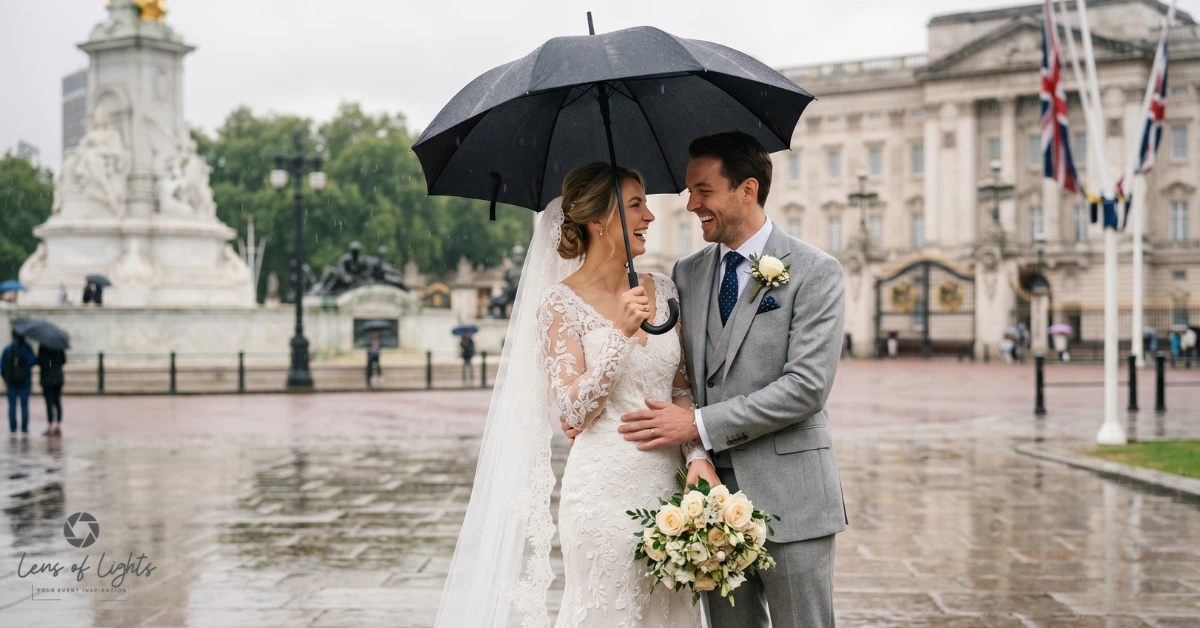
Umbrellas are the most obvious rainy wedding day prop – and the most misused. Couples holding matching clear umbrellas and smiling directly at the camera produce a stock photo, not a wedding portrait.
Use umbrellas in these ways instead:
- One umbrella, held by whoever is taller. This creates a natural lean-in posture and keeps the couple physically close. The tilt of the umbrella toward the camera gives the photographer a natural frame.
- Walking away from the camera, the umbrella is between the couple and the lens. This gives an editorial, story-driven shot rather than a posed portrait.
- A coloured or patterned umbrella against a grey stone background. The colour pop against a monochrome backdrop is a deliberate compositional choice, not an accident.
- Tipping the umbrella back while laughing or kissing. The umbrella becomes a secondary prop, not the focus. The emotion is the subject.
Avoid: white umbrellas (they wash out in overcast light), clear umbrellas held perfectly level (they block the faces), and matching umbrellas for both people (they make the couple look like a brand, not a couple).
Puddle Reflection Shots: How They Work and When to Ask for One
A puddle reflection shot is taken by placing the camera at ground level and using a standing pool of water to reflect the couple above it, creating a symmetrical or layered image. The technique requires a flat, still surface – a car park, a stone courtyard, or a paved path work well.
To get this shot:
- After rain eases (even briefly), ask your photographer to scout for a flat, standing puddle at least 60cm across.
- Stand directly behind or above the puddle, shoulder-width apart.
- The photographer positions the camera low, pointing up slightly, with the puddle in the foreground.
- Keep still for 2-3 seconds so the water settles.
The result is one of the most shared wedding photography formats on Instagram and Pinterest in the UK (Bridebook, 2024). It takes under five minutes to set up and requires no additional equipment.
The best light for puddle shots is just after rain, when the sky is still overcast but the ground is wet. Direct sun creates glare on the water surface and reduces the reflection quality.
How to Protect Your Wedding Attire in Wet Weather Without Ruining the Photos
Protecting a wedding dress or suit in the rain is mostly about movement and planning, not waterproofing products.
- Dress bustling. If the dress has a train, ask your seamstress in advance about adding a bustle (a hidden hook-and-loop system that lifts the train). This is a five-minute alteration that saves the dress from mud and wet ground.
- A second pair of shoes. Wear your ceremony shoes for indoor shots, then switch to a waterproof flat for outdoor portraits. Most photographers can shoot from the ankle up or adjust framing to exclude footwear.
- A natural-fibre veil rather than synthetic. Polyester veils go flat and static in humidity. A silk or silk-blend veil holds movement and looks better in overcast light.
- Dry bags for the morning. Keep everything in sealed bags until the moment it is needed. Humidity in a UK autumn morning will work on hair and fabric before a drop of rain falls.
- An assistant or bridal party member assigned to the dress. One person whose job is to hold the hem, hand over umbrellas, and manage the transition between locations makes the logistics work on the day.
What to Do When Rain Is Forecast: A Same-Day Action Plan
If the forecast shows rain on your wedding morning, work through this sequence – do not wait and hope.
- Contact your photographer by 8 am. Confirm the wet-weather plan is active, not the original outdoor plan.
- Notify your venue coordinator. Ask which indoor spaces are available for portraits and whether furniture can be moved to clear window areas.
- Adjust the portrait window in your timeline. If outdoor portraits were planned immediately after the ceremony, move them to later in the day when the rain may ease, or extend the indoor portrait session.
- Brief the wedding party. Tell them which entrance to use, where umbrellas are stored, and what the revised portrait plan looks like. This removes the confusion and the delay that come from people finding out changes on the day.
- Buy or designate umbrellas the night before. Matching or coordinated umbrellas for the bridal party photograph better than a mix of whatever guests brought. A set of six black or white umbrellas costs under £30 and is worth having regardless of the forecast.
5 Mistakes Couples Make with Rainy Wedding Photography
Avoiding these five mistakes is the difference between salvaged photos and genuinely great ones.
- Cancelling all outdoor time the moment it rains. A 10-minute window between showers is enough for an umbrella portrait and a puddle reflection shot. Stay ready to move outside quickly.
- Using a patterned or dark umbrella. A red umbrella casts red light on your faces. A dark umbrella blocks all light and puts both subjects in shadow. Clear acrylic only.
- Not telling your photographer it might rain. Check the forecast 72 hours out and brief your photographer explicitly. They need to pack rain covers, lens cloths, and may want to scout alternative locations.
- Skipping the post-rain mist window. The 15-20 minutes immediately after heavy rain stops are often the most beautiful light of the day. Build a “be ready to move” instruction into your timeline.
- Choosing shoes without thinking about wet ground. Thin satin heels disappear into soft wet grass. Platform shoes or block heels with a waterproof finish hold shape better and photograph cleaner.
Frequently Asked Questions
Does rain actually ruin wedding photos?
Rain does not ruin wedding photos when the couple and photographer have a wet-weather plan in place. Overcast light is flattering for portraits, and rain adds texture and atmosphere to backgrounds. The couples most affected by rain are those who had no backup plan and lost time reacting to conditions rather than working with them.
What should I do if it rains on my wedding day?
Activate your wet-weather plan first thing in the morning. Contact your photographer, notify your venue coordinator, adjust your portrait timeline, and brief the wedding party on revised locations. Prepare umbrellas the night before so you are not scrambling on the day. Focus on what rain makes possible – reflection shots, moody skies, warm indoor light – rather than what it prevents.
How do wedding photographers shoot in rain without damaging their cameras?
Professional cameras used by working wedding photographers are weather-sealed, which means the body is built to resist water ingress during normal shooting conditions including rain. Canon R5/R6, Nikon Z6/Z8, and Sony A7 series bodies all carry weather resistance ratings. Lenses vary – ask your photographer to confirm their kit is rated for outdoor use in wet conditions.
What is the best time of year for a UK wedding if you want to avoid rain?
June and September are statistically the drier months for outdoor weddings in England (Met Office, 2023). However, no UK month guarantees dry weather, and regional variation is significant – Scotland receives nearly double the rainfall of the south-east of England. Planning for rain regardless of month is the only reliable approach.
How long do outdoor portrait sessions take in the rain compared to dry weather?
Allow an extra 15-20 minutes for outdoor portrait sessions in wet weather. Moving between covered spots, managing umbrellas, and waiting for brief dry windows between showers all add time. Build this into your run sheet rather than cutting another part of the day to compensate.
Should I hire a second photographer for a rainy wedding day?
A second photographer (also called a second shooter) is worth considering for any wedding over 80 guests, but rain makes it more valuable specifically because it gives you simultaneous coverage of indoor and outdoor locations. If rain moves portraits inside while guests are still outside, one photographer cannot cover both.
Can I get a refund or reschedule if it rains on my wedding day?
No UK photographer’s standard contract includes rain as grounds for rescheduling, because rain is a normal weather condition, not a force majeure event. Weather cancellation clauses in venue and photographer contracts typically apply to extreme events – flooding, storm damage, or venue closure – not ordinary rainfall. Check your specific contract and wedding insurance policy for the exact terms.
Related Articles:
Wedding photography contract: 10 things every UK couple must check
Quick Overview A wedding photography contract is a legally binding...
Read More
Documentary vs Posed Wedding Photography in UK: Which Style is Right for You?
Documentary wedding photography captures your day as it naturally unfolds...
Read More
Nigerian wedding photography in London: Owambe colour, culture & celebrations
Photographing a Nigerian wedding in London involves more than standard...
Read More